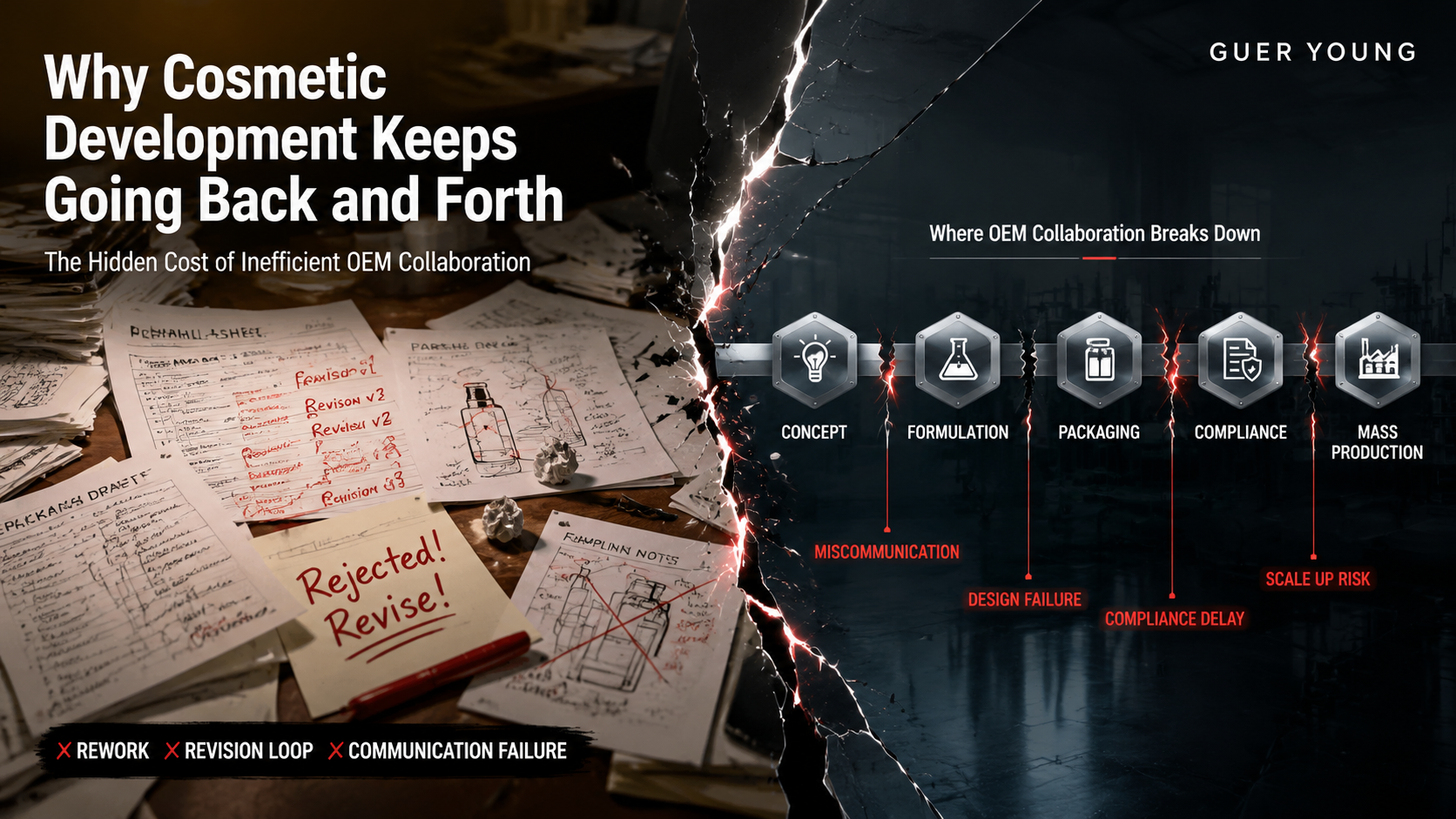
In the development process of color cosmetics, brands are often not limited by creativity, but by breakdowns in execution—slow sampling, repeated communication loops, unfeasible packaging structures, or compliance issues discovered too late in the process.
These challenges usually come from one root cause: the OEM does not provide complete support at the early development stage, forcing brands into costly revisions and delayed launches.
For cosmetic brands, a mature OEM/ODM partner should not only manufacture products, but also help control risks from concept to mass production before the formula is even finalized.
1. Formulation Development: Turning Ideas into Real Products
In the early stage, brands often only have a vague idea—such as “a more lengthening mascara” or “a more natural brow gel”—without a clear technical direction.
At this point, OEM support should be structured and technical, including:
Breakdown of performance goals into formulation pathways
Ingredient selection and substitution recommendations
Regulatory adaptation for different markets (Asia / EU / US)
Iterative lab sampling and optimization
In a mature development system, efficiency can reach:
This is not about rushing R&D, but about eliminating inefficiencies through standardized development workflows.
2. Structural Design Evaluation: Avoiding “Beautiful Design, Impossible Production”
In color cosmetics, performance is only part of the equation—structure is equally critical. Components such as brush design, tube resistance, and dispensing consistency directly affect user experience.
During development, OEMs should evaluate:
Manufacturability of packaging structures
Compatibility between applicators and formulas
Mold development risk assessment
Cost and yield impact analysis
Many collaboration issues arise when this step is ignored, leading to redesigns later in the process.
At this stage, GUER YOUNG provides feasibility evaluation alongside prototyping to ensure that creative concepts can be reliably translated into manufacturable products.
3. Regulatory Compliance: If It Can’t Be Sold, It Doesn’t Matter
A product that fails compliance review cannot enter the market, making this one of the highest-risk areas in development.
OEM support should include:
INCI ingredient compliance screening
MSDS / COA documentation support
EU CPNP regulatory assessment
FDA market compliance guidance
ISO / Sedex-certified manufacturing system alignment
For brands targeting multiple markets, this step determines whether the product can scale globally.
4. Sampling Speed & Iteration Cycle: Capturing Market Timing
The cosmetics industry moves fast, and development speed directly impacts market opportunity.
A capable OEM should provide:
Sample turnaround within 3 days
Parallel development of multiple versions
User experience-driven optimization
Rapid iteration cycles to reduce trial costs
Slow development cycles often result in missed trend windows—even if the product itself is strong.
5. Mass Production Feasibility: Preventing “Works in Sample, Fails in Production”
One of the most common failure points occurs at the final stage: the sample works, but cannot be scaled.
OEMs should evaluate early:
Process stability and batch consistency
Minimum order quantity (MOQ) structure
Unit cost at scale
Production line compatibility and lead time
During real projects, GUER YOUNG simulates mass production conditions during sampling to ensure that development decisions already align with manufacturing reality.
6. Integrated Development Capability: From Execution to System Thinking
When an OEM has a mature development system, its role goes beyond manufacturing—it becomes a risk-control partner for the brand.
A complete system typically includes four core capabilities:
Formulation development support
Structural design evaluation
Regulatory compliance screening
Mass production feasibility assessment
If any of these elements is missing, the development chain becomes unstable, increasing the risk of delays and product failure.
In practice, GUER YOUNG integrates these four capabilities into a unified development process, allowing brands to validate feasibility before mass production begins.
Conclusion: Capability Summary
For cosmetic brands, the core challenge during product development is not whether a product can be created, but whether it can be developed reliably, compliantly, and at market speed.
The value of an OEM should not be limited to sample delivery. It should be reflected in its ability to manage the entire development cycle—formulation logic, structural feasibility, compliance risk, and production scalability.
When these capabilities operate as a system, development cycles become shorter, rework is reduced, and time-to-market becomes significantly more predictable.
For brands focused on lash care, eye makeup, and customized cosmetic development, the role of GUER YOUNG is to integrate formulation engineering, structural validation, and manufacturing logic early in the process—ensuring that by the time a product reaches production, it is already built on a scalable and market-ready foundation.






