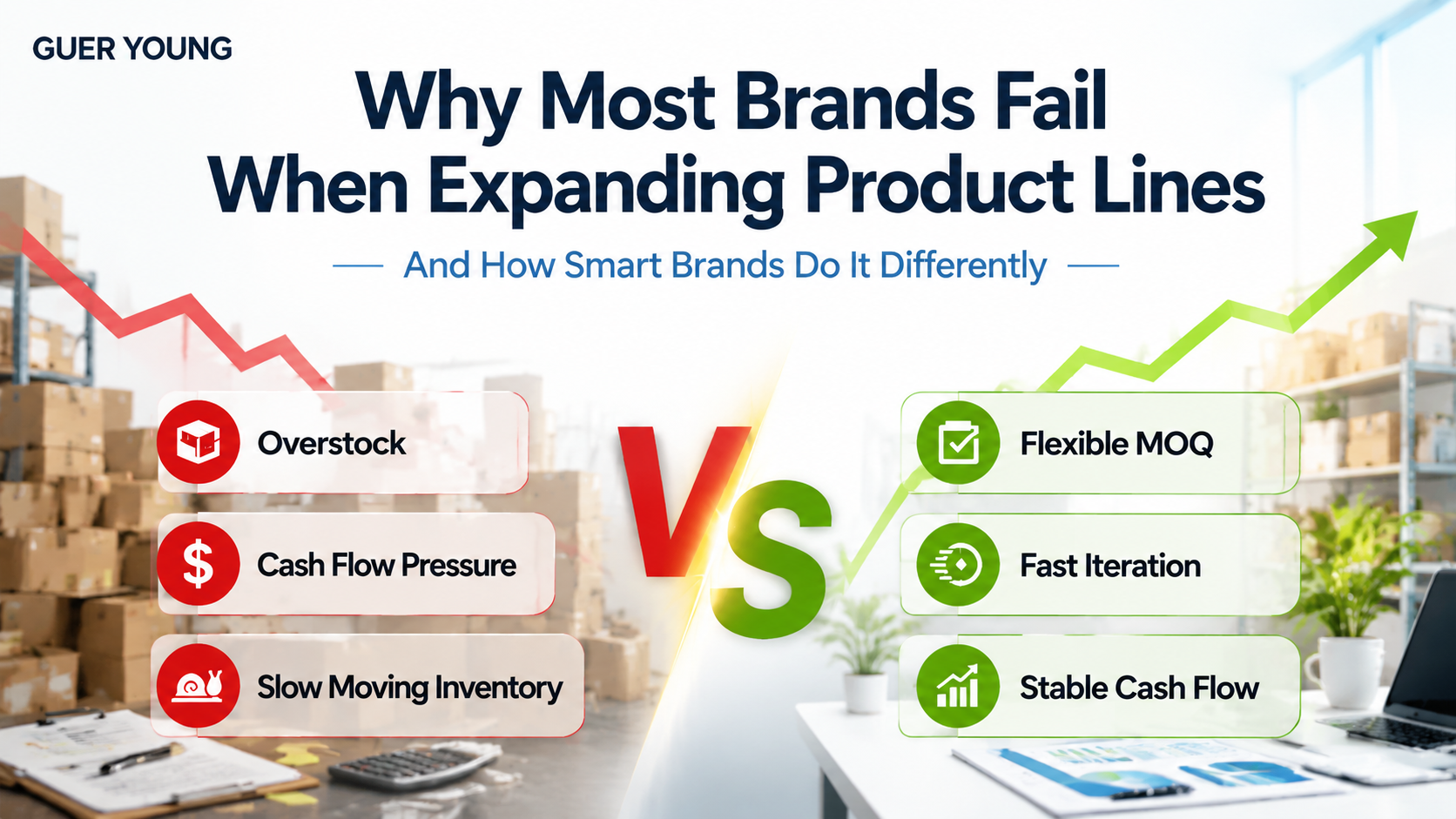
In the cosmetics and beauty industry, expanding a product portfolio is a natural stage of brand growth. However, for brands with existing sales traction, the real challenge is not market demand—but inventory exposure and production risk.
As SKU structures become more complex, brands must shift from volume-driven expansion to system-driven scalability.
1. MOQ and Production Planning Define Inventory Risk
The first control point of inventory risk is MOQ (minimum order quantity) and production flexibility.
In traditional manufacturing models, high MOQs force brands to commit to large stock volumes upfront. If demand underperforms, excess inventory becomes a financial burden.
A more scalable model typically includes:
MOQ starting from 500 pcs
Small-batch rolling production
Flexible SKU switching across batches
In advanced OEM/ODM systems such as GUER YOUNG, production scheduling is aligned with order flow, allowing brands to distribute production across multiple SKUs instead of concentrating risk in a single batch.
2. R&D Capability Determines Expansion Speed
The speed of product line expansion is directly linked to R&D strength.
A mature R&D system typically includes:
In optimized workflows, sample development usually takes 3–7 days, while mass production can be completed within 7–15 days depending on formulation complexity.
In practice, GUER YOUNG supports formula adaptation based on existing bestsellers, enabling brands to extend into adjacent product categories without restarting development from scratch.
3. Manufacturing System and GMP Standards Enable Scalability
Product expansion is not only a formulation challenge—it is also a manufacturing system challenge.
A scalable cosmetic production system is built on:
GMP-compliant manufacturing lines
Standardized mixing and filling processes
Batch traceability and process control systems
Quality control is typically structured into three stages:
IQC (Incoming Quality Control)
IPQC (In-Process Quality Control)
FQC (Final Quality Control)
All processes are managed under AQL sampling standards rather than relying on full inspection models, ensuring both efficiency and consistency across multi-SKU production.
4. Compliance Systems Enable Market Access
For export-oriented beauty brands, compliance determines market entry capability.
The regulatory framework generally includes three categories:
ISO Systems
Market Compliance
Technical Documentation
These documents are not only regulatory requirements but also foundational infrastructure for entering EU and US markets.
5. Structured Expansion vs. SKU Accumulation
A common mistake in product expansion is increasing SKU count without building structural relationships between products.
A more sustainable approach is structured expansion:
Extending lash growth serums into care and strengthening variants
Segmenting products by usage scenarios (daily vs. professional makeup)
Developing tiered product systems based on user needs
This creates a connected product ecosystem rather than isolated items.
In several projects, GUER YOUNG has supported European brands and private label brands in designing extension lines based on existing hero products, ensuring technical consistency across the portfolio rather than fragmented development.
Conclusion
Expanding a beauty product line is not about increasing the number of products—it is about building a controlled and scalable system.
By optimizing MOQ, shortening sampling cycles, implementing GMP manufacturing systems, and ensuring compliance readiness, brands can expand portfolios without significantly increasing inventory risk.
For beauty brands moving toward multi-SKU structures, the key is system capability rather than individual product launches.
Within this framework, GUER YOUNG provides R&D and flexible manufacturing support as a structural component, helping brands maintain a balanced relationship between growth and inventory exposure.






