Read in English | Lire en Français | Leer en Español | Lesen auf Deutsch
For founders of independent cosmetics brands, launching a new product is both an opportunity for growth and a potential cash flow risk. Every stage—from R&D and sampling to production and marketing—requires continuous investment. However, if market response falls short, unsold stock can quickly pile up, tying up cash flow and limiting future product development.
In the fast-moving beauty industry, where trends shift quickly and consumer choices are abundant, even a small misjudgment can lead to overstocked inventory sitting in warehouses. That’s why managing launch strategy and production scale is a critical survival skill for every emerging brand.
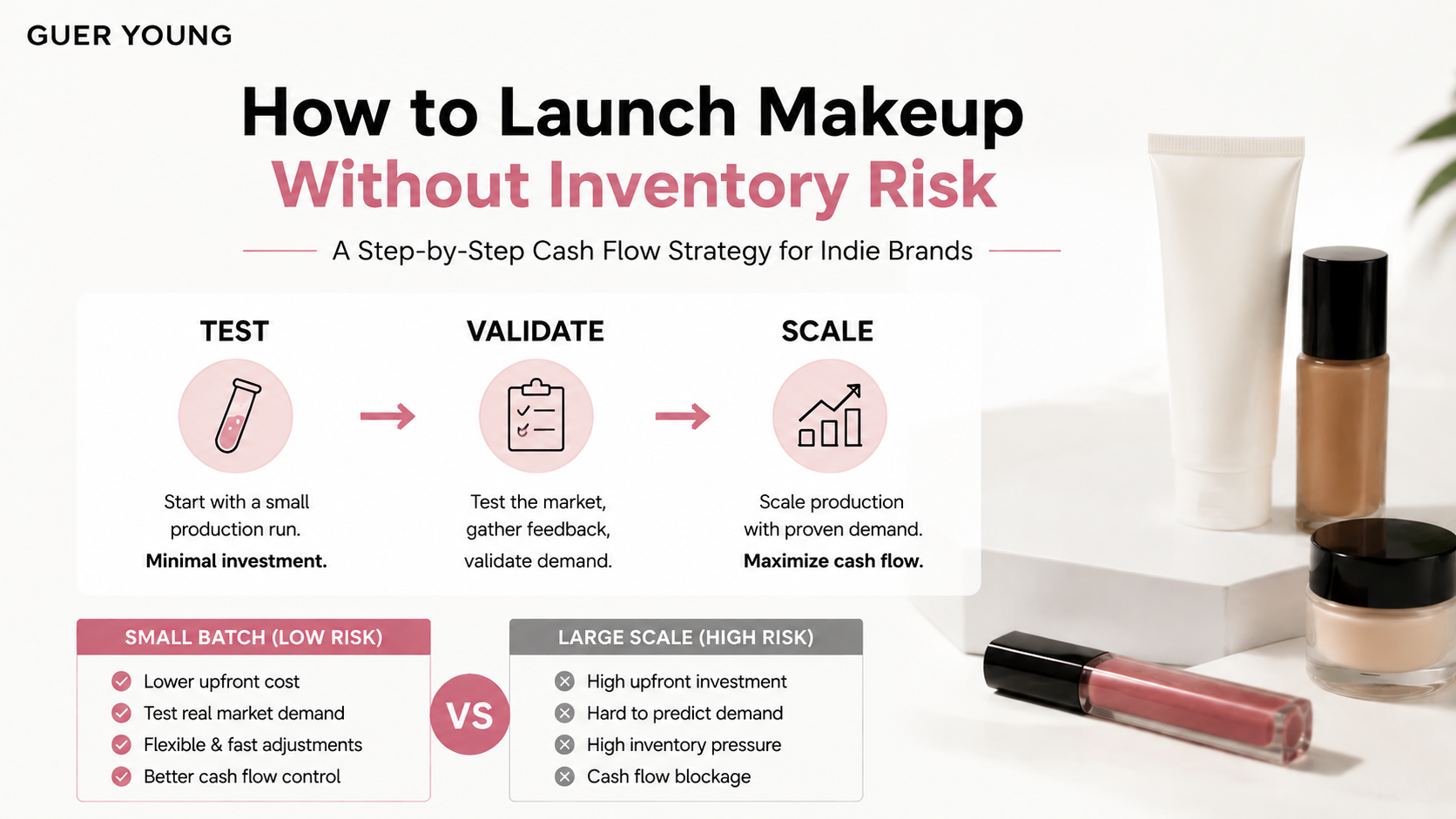
In practice, platforms like GUER YOUNG, which specialize in beauty care and cosmetic manufacturing, help brands reduce inventory risk at the source. Through OEM/ODM services and flexible small-batch production, brands can test market demand first and scale gradually, significantly reducing the financial pressure caused by overproduction.
1. The Real Cause of Inventory Problems: It’s Not “Slow Sales,” It’s Misalignment
Many founders assume inventory issues come from “products not selling well,” but in reality, the root cause is often misalignment:
Product does not match target customer needs
Launch timing does not align with market demand
Distribution scales too fast without conversion support
Initial production volume is too large without validation
In other words, inventory is rarely just a sales issue—it is a decision-making issue.
Especially in the cosmetics industry, where product lifecycles are short, missing the optimal market window can quickly turn a promising product into dead stock. This is why more brands are adopting a “small batch testing + rapid iteration” approach.
2. Replace Big Bets With Small-Scale Validation
For independent brands under cash flow pressure, the goal of the first production run is not profit—it is validation.
1. Minimum Viable Production (MVP Thinking)
Start with small production volumes, such as:
The goal is not full market coverage, but real feedback validation.
2. Phased Scaling
Scale production based on real data:
Phase 1: Testing (30% capacity)
Phase 2: Expansion (50% capacity)
Phase 3: Scaling (remaining 20%)
This prevents large-scale upfront inventory risk.
3. Pre-Order Strategy
Pre-orders via social media or independent stores can validate demand early while also improving cash flow.
3. Product Strategy Directly Impacts Inventory Risk
Inventory issues often originate from product strategy flaws.
Common mistakes in cosmetics launches include:
1. Overly Complex Functionality
The more complicated the product, the higher the consumer understanding barrier—and the lower the conversion rate.
2. Too Many Shades
Early-stage brands should avoid excessive SKU variety, which often leads to slow-moving inventory.
3. Unclear Positioning
If a product tries to appeal to both premium and mass markets, it often fails to convert either.
The right approach is:
One hero product first, then line expansion.
4. Supply Chain Flexibility Determines Cash Flow Safety
Many inventory problems are not caused by the market, but by rigid supply chains.
A strong manufacturing system should offer:
Small-batch rapid sampling
Flexible production switching
Modular material procurement
On-demand manufacturing instead of bulk stocking
This is where GUER YOUNG provides value. With its mature OEM/ODM system, it enables brands to adjust production volume at different stages, reducing the risk of producing inventory before the market is ready.
5. Data-Driven Decisions Over Gut Feeling
Inventory problems often stem from intuition-based decisions rather than data.
Brands should track three key data categories:
1. Conversion Metrics
Website conversion rate
Ad ROI
Landing page engagement
2. Customer Feedback
Repeat purchase rate
Review keywords
Social media mentions
3. Channel Performance
Better data leads to lower inventory risk.
6. Marketing Timing Matters More Than the Product Itself
Many product failures are not due to poor quality—but poor launch timing.
A strong launch should follow a three-stage structure:
1. Pre-Launch Phase
2. Launch Phase
3. Post-Launch Phase
Without proper timing, products often sit in warehouses before demand even arrives.
7. The Ultimate Solution: Let the Market Drive Production
The core issue of inventory is whether production is driven by demand or assumptions.
Healthy product development always follows market signals, not fixed production plans.
In this system, GUER YOUNG supports independent brands through integrated R&D and manufacturing solutions, enabling rapid testing in early stages, stable scaling in mid stages, and structured expansion in later stages—creating a healthier inventory and cash flow cycle.
Conclusion
When new cosmetic products turn into inventory, the issue is rarely isolated—it is a systemic problem involving product design, production planning, and market validation.
For independent beauty brands, success is not about how much you produce, but how effectively each batch is validated by the market.
Once you shift from a production-driven mindset to a market-driven strategy, inventory stops being a burden—and becomes a controllable part of your growth system.






