Read in English | Lire en Français | Leer en Español | Lesen auf Deutsch
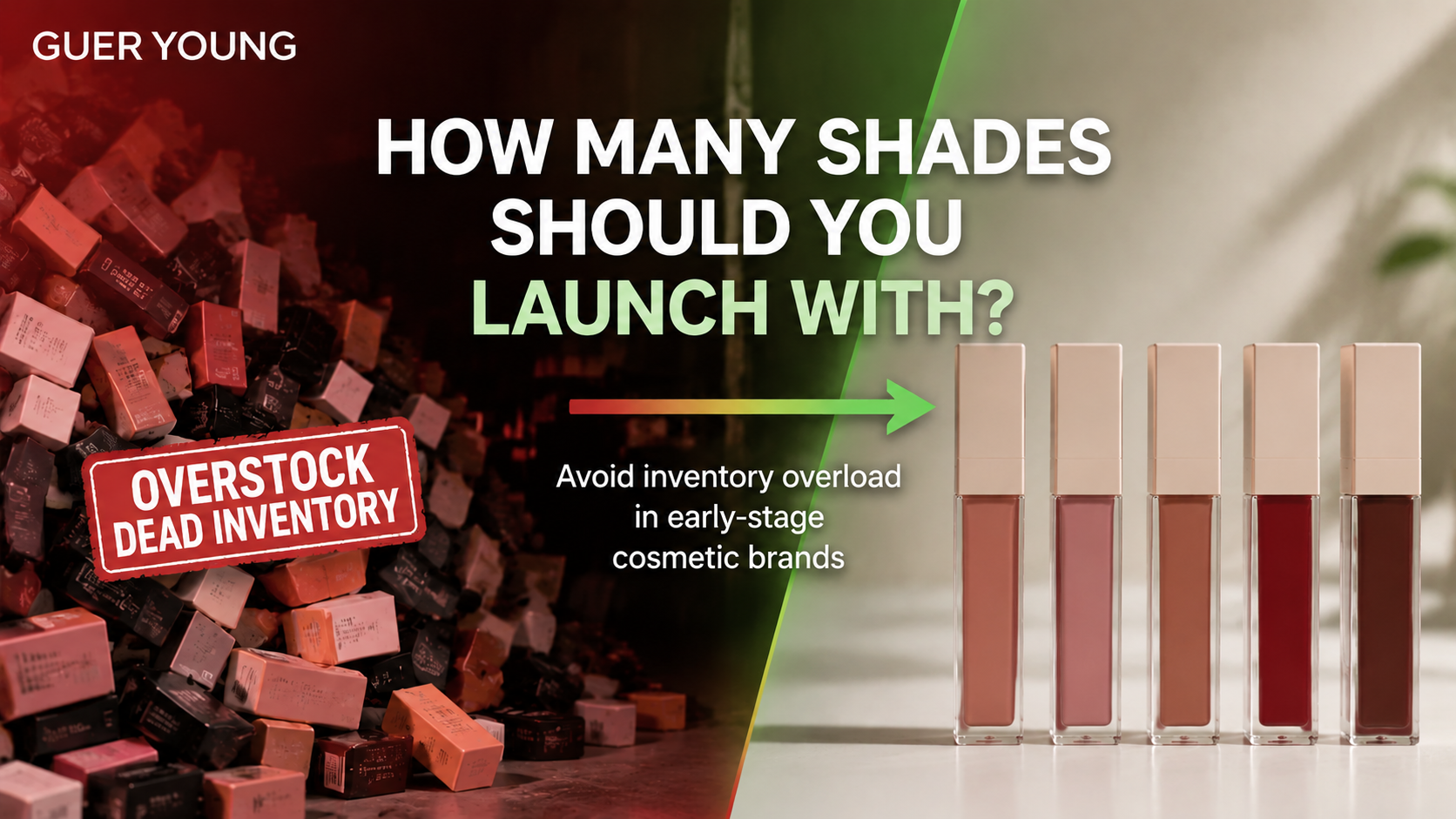
For independent cosmetic brand founders, deciding how many shades to launch in the first product drop is not a simple product development question—it is a strategic decision that directly impacts cash flow, inventory risk, and long-term brand survival. Too few shades can limit market reach, while too many often lead to excess inventory and costly overstock issues. In real-world product development, experienced manufacturers like GUER YOUNG often see that incorrect shade planning is one of the most common yet underestimated causes of early-stage brand failure.
1. Shade Planning Mistakes Often Start With “Trying to Serve Everyone”
Many emerging beauty brands make the same mistake at the beginning: they try to cover every possible skin tone from day one. As a result, a foundation or complexion product line may expand from 5 shades to 10 or even 15 shades before any real market validation.
However, actual sales data usually tells a very different story. In most cases, only 2–3 core shades drive the majority of revenue, while the rest sit in storage with slow or minimal turnover.
The root issue is not product quality—it is the lack of data-driven shade architecture. Without real market feedback, expanding shade ranges too early only amplifies supply chain risk and increases the likelihood of markdowns and write-offs.
2. The Ideal Starting Point: 3–5 Core Shades
Based on industry experience, most successful indie beauty brands begin with a “minimum viable shade range”:
3 shades: For ultra-lean market testing
4 shades: Covers light, medium, and deep tones effectively
5 shades: Suitable for brands with early distribution or influencer traction
The goal is not to cover every possible consumer, but to focus on the most commercially viable segments first.
At this stage, success is defined by validation—not completeness.
3. Shade Strategy Is About Sales Structure, Not Visual Completeness
Many founders evaluate shade ranges based on how “professional” or “complete” they look on a display. But in reality, revenue concentration matters far more than visual symmetry.
Key questions should be:
Which shades generate 80% of total sales?
Which shades serve as expansion drivers?
Which shades are mainly for inclusivity perception but low in turnover?
Without answering these questions early, brands often end up with “balanced inventory that doesn’t sell evenly”—a silent profitability killer.
During early-stage product planning, GUER YOUNG often advises clients to prioritize market testing first, then refine shade architecture based on real sales data rather than assumptions.
4. The Real Cause of Inventory Buildup Is Structural, Not Product-Related
Many brands assume inventory problems come from weak sales performance. In reality, the most common issue is structural imbalance in shade distribution:
Best-selling shades constantly out of stock
Low-performing shades accumulating in warehouses
Replenishment cycles forced to follow slow-moving inventory
This creates a cash flow bottleneck while preventing high-performing shades from scaling efficiently.
A more sustainable model is a dual-layer system: core shades for revenue generation and extended shades for market expansion, introduced gradually based on demand signals.
5. How to Expand Your Shade Range Step by Step
Once the initial product line proves successful, shade expansion should be fully data-driven:
Identify sales concentration across existing shades
Introduce micro-variations around high-performing tones
Eliminate underperforming shades early
Segment shades by season, region, or channel when needed
This approach prevents unnecessary complexity and allows the shade system to evolve organically rather than being overbuilt from the start.
6. Testing Matters More Than the Number of Shades
Many brands overlook a critical truth: the number of shades is not the core issue—the validation system is.
Before scaling production, brands should leverage:
These methods significantly reduce inventory risk while improving shade accuracy and conversion rates.
7. Manufacturing Flexibility Defines Your Shade Ceiling
From a production standpoint, shade range expansion is not only a marketing decision—it is also a supply chain capability issue. The more flexible your manufacturing system, the lower the risk of expanding shade ranges.
For example, GUER YOUNG provides OEM/ODM solutions that support small-batch, multi-shade testing, enabling emerging brands to validate products without committing to large inventory volumes. This approach is especially valuable for indie beauty brands looking to scale sustainably.
8. Final Thoughts: Shade Planning Is a Business Decision, Not Just a Creative One
The number of shades in a cosmetic product line is ultimately a decision about risk management and growth strategy. In the early stage, fewer but more targeted shades almost always outperform a fully expanded range.
For independent beauty brands, success is not about launching a “perfect” shade range from day one—it is about starting lean, learning fast, and scaling based on real demand signals.
When product strategy, market feedback, and supply chain capabilities work in alignment, shade planning becomes a growth engine rather than an inventory burden. GUER YOUNG continues to support this process by helping brands bridge the gap between formulation, customization, and scalable production.






