
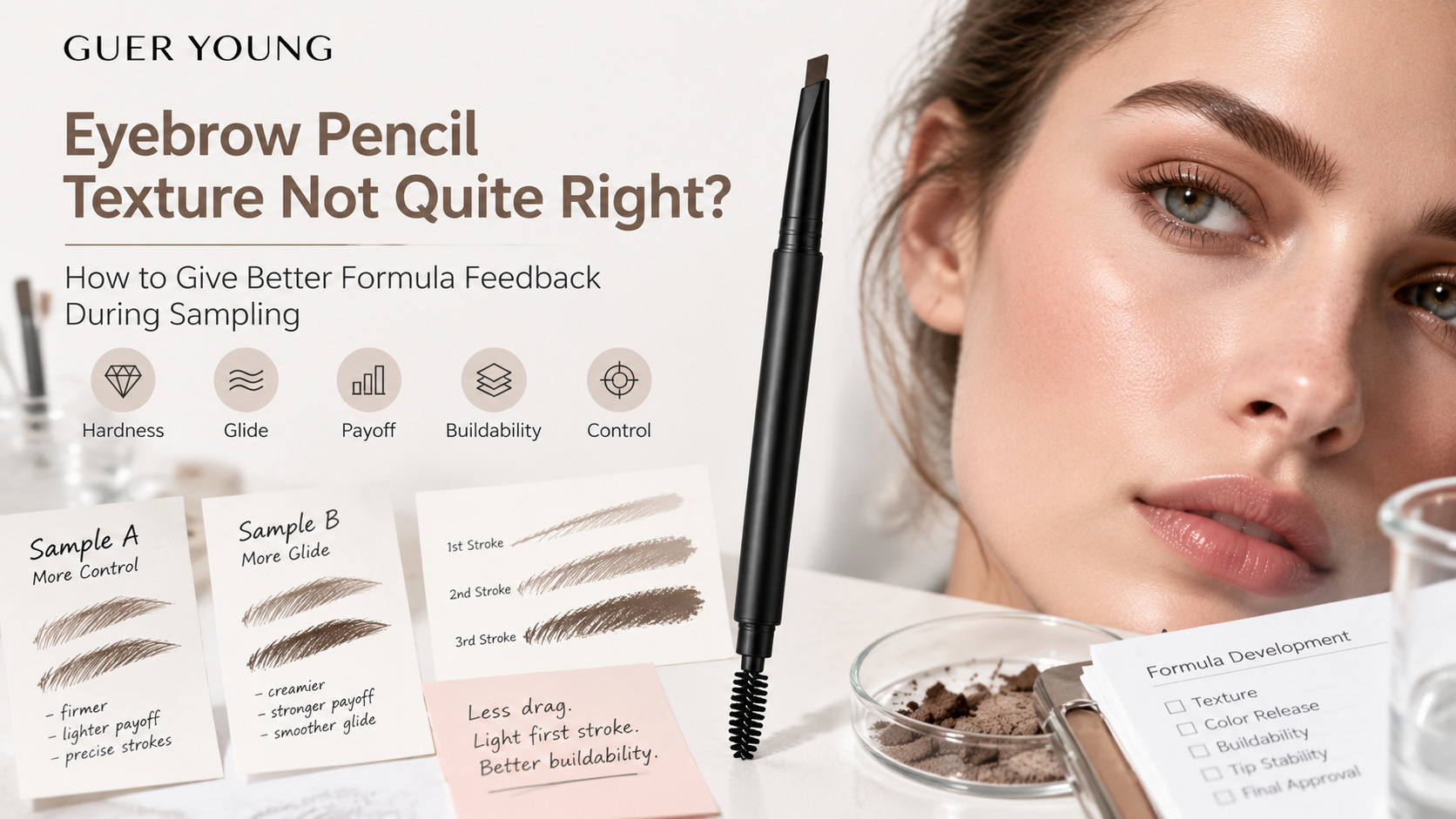
Eyebrow Pencil Texture Not Quite Right? How to Give Better Formula Feedback During Sampling
Read in English | Lire en Français | Lesen auf Deutsch
Your latest eyebrow pencil sample is close.
The shade is right. The packaging direction is confirmed. But when your product team tests it, the feedback is still:
“Something about the texture doesn’t feel right.”
Then comes the difficult part—explaining exactly what needs to change.
“Can you make it softer?”
“Maybe a little creamier?”
“We want it smoother, but not too pigmented.”
These comments describe how the sample feels, but they are not always precise enough to guide an eyebrow pencil formula adjustment.
For beauty brands developing or expanding a Brow Collection, defining the right eyebrow pencil texture means going beyond “hard” or “soft.” You need to define how the pencil should glide, how much color it should release on the first stroke, how naturally it should build, and how much control the user should have.
The real question is not:
“How soft should the pencil be?”
It is:
“What should the consumer experience from the first stroke to the finished brow?”
Why “Make It Softer” Is Not a Clear Formula Brief
The feel of a brow pencil formula comes from the balance between waxes, oils, powders, pigments, and other structural ingredients.
Adjusting that balance can change more than softness.
Increasing creaminess may improve glide but also increase first-stroke payoff. Increasing eyebrow pencil hardness may improve control while making color more difficult to release.
That is why repeatedly asking for “softer,” “creamier,” or “smoother” can lead to unnecessary sampling rounds.
Instead of:
“Make it softer.”
A more useful direction might be:
“Reduce drag while keeping the first stroke light and easy to control.”
The second version gives the formulation team a performance target rather than a subjective texture description.
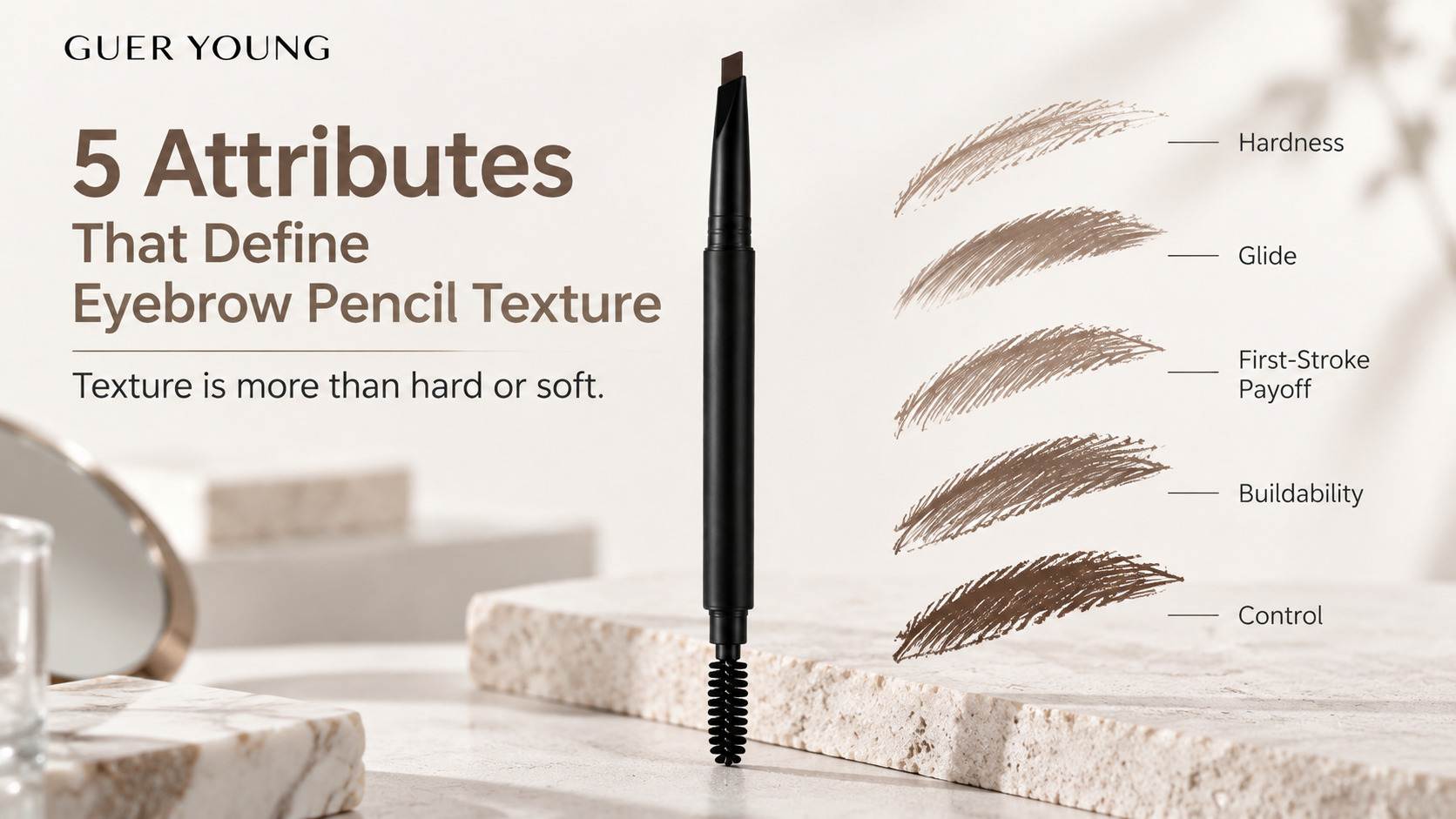
5 Attributes That Define Eyebrow Pencil Texture
When evaluating samples, break eyebrow pencil texture into specific attributes.
1. Hardness
How much resistance does the core have when it contacts the brow?
Some firmness can help create precise, hair-like strokes. But if users need too much pressure to see color, the formula may have more resistance than the target experience requires.
2. Glide
How easily does the pencil move across the brow?
A creamy eyebrow pencil may offer excellent glide, but glide alone does not make a good formula. The user still needs enough control to create the intended brow look.
3. First-Stroke Payoff
How much color appears on the first pass?
For natural brow looks, the target may be a lighter first stroke rather than immediate full intensity.
This also affects perceived eyebrow pencil pigmentation.
4. Buildability
What happens after the second and third stroke?
A buildable formula should allow consumers to increase intensity gradually without the result becoming patchy or suddenly too heavy.
5. Control
Can the user place color exactly where they want it?
For many brow products, the ideal texture is not simply smooth. It is:
Smooth, buildable, and controlled.
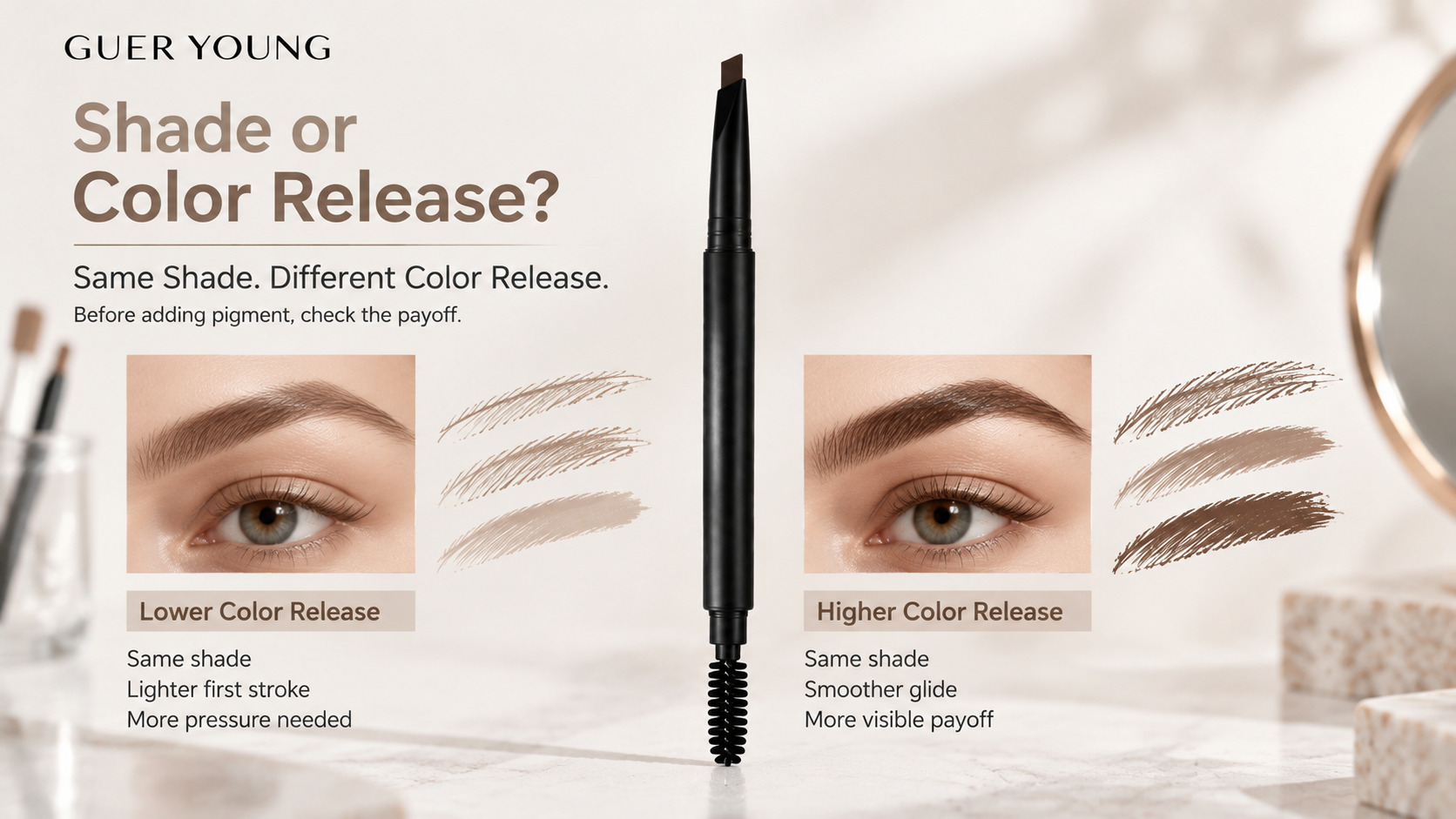
Texture and Pigmentation Are Not the Same Problem
A common piece of sample feedback is:
“The color is too light.”
That sounds like a pigment issue, but it may actually be a color-release issue.
If the formula has too much resistance, not enough product may transfer onto the brow. The shade itself could be correct while the payoff remains too low.
Likewise, a creamier texture can transfer more product in one pass, making the same shade appear stronger.
Before changing eyebrow pencil pigmentation, ask:
Is the shade wrong—or is the color release wrong?
Instead of:
“We need more pigment.”
Try:
“The shade direction is correct, but the first two strokes are too light. We want slightly more color release without losing line control.”
That creates a much clearer direction for a custom eyebrow pencil formula.
Start With the Makeup Result
Before deciding whether a pencil should be harder or creamier, define what the consumer should be able to create.
For natural hair-like strokes, the target might be:
Light first-stroke payoff + precise control + gradual buildability
For quick brow filling:
Smoother glide + faster color release + easy coverage
For a beginner-friendly brow pencil:
Controlled initial payoff + easy layering + forgiving application
This connects brand positioning directly to formula development.
Instead of asking for “a medium-hard pencil,” your team can describe the experience the formula needs to deliver—giving your eyebrow pencil manufacturer a clearer starting point.
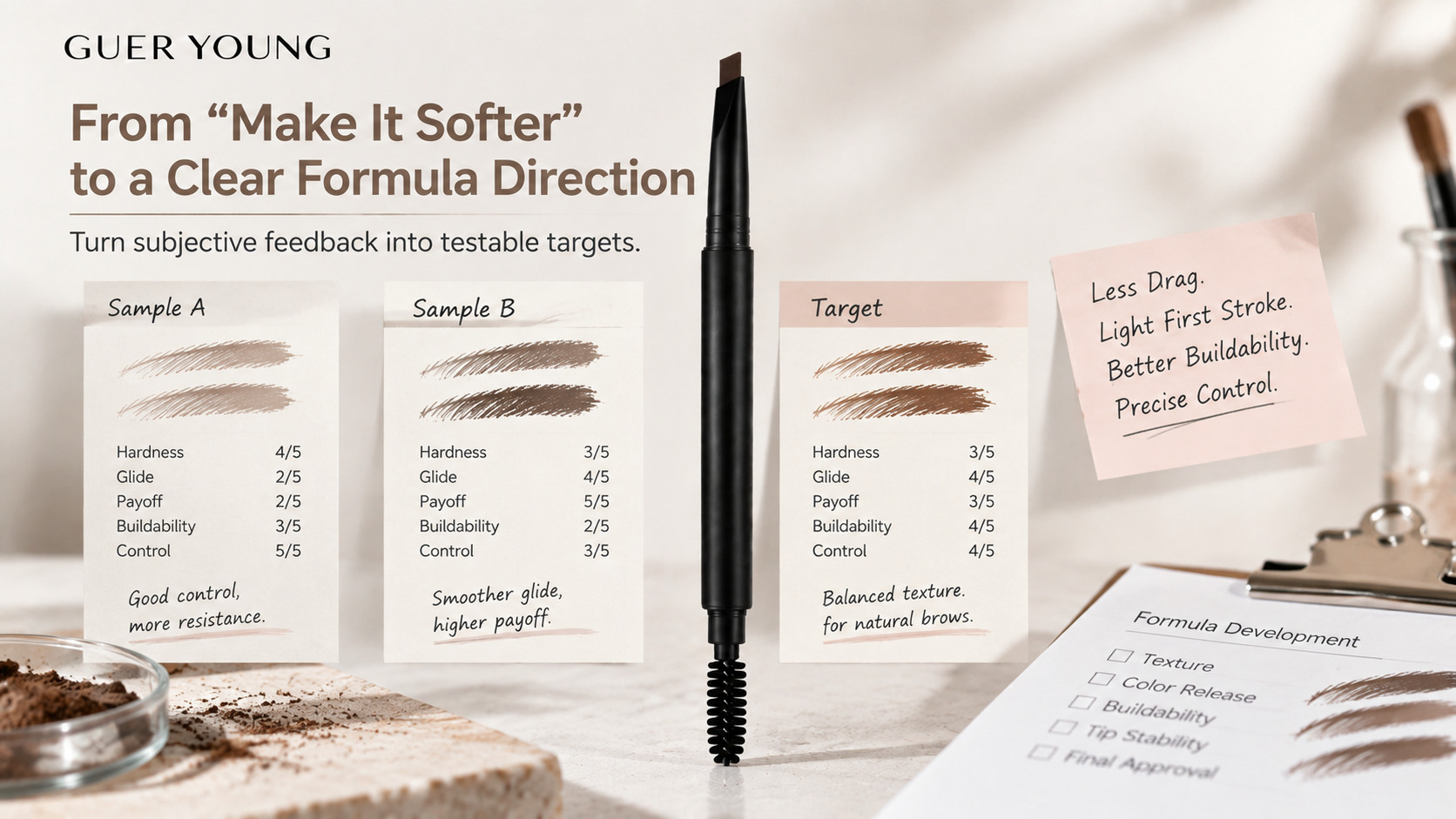
Case Study: Turning “Can You Make It Softer?” Into a Formula Direction
We worked with a beauty brand expanding its Brow Collection.
After several sampling rounds, the product was close, but the team still felt something was missing.
The first version offered good line precision but required more pressure than they wanted. A creamier version improved glide, but the first-stroke payoff became stronger than their target makeup look required.
Their initial feedback was:
“Can you make it softer?”
At GUER YOUNG, instead of treating “softer” as the final instruction, we went back to the intended consumer experience.
Together, we defined five targets:
clean, natural hair-like strokes;
light color payoff on the first stroke;
gradual buildability over two to three passes;
smoother glide without losing control;
sufficient stability for the selected fine-tip format.
The brief was no longer:
“Make it softer.”
It became:
Light first-stroke payoff + buildable pigmentation + smooth glide + precise control + appropriate tip stability.
We then rebalanced the wax, oil, powder, and pigment systems around these targets rather than simply making the eyebrow pencil formula softer.
The samples were evaluated in the actual component through repeated application and different use angles, allowing the team to judge texture in a more realistic context.
The final formula was not simply harder or softer.
It was closer to the experience the brand had been trying to describe from the beginning.
This reflects an important part of GUER YOUNG's approach to custom eyebrow pencil development:
Turning “It doesn’t feel right” into a formula direction that can be tested, compared, and adjusted.
How to Write a Better Eyebrow Pencil Formula Brief
When reviewing samples, try translating subjective comments into measurable performance targets.
Instead of:
“Make it softer.”
Try:
“We want slightly less drag than Sample A while keeping the first-stroke payoff light and controlled.”
Instead of:
“It’s too pigmented.”
Try:
“The shade direction is correct, but the first-stroke payoff is too high. We want the color to build more gradually over two to three passes.”
Instead of:
“We want it like this benchmark.”
Try:
“We like the benchmark’s glide and line control, but want slightly lighter initial payoff.”
A benchmark tells your supplier what you like.
A clear formula brief explains why you like it.
That difference can reduce trial and error during eyebrow pencil product development.
Use an Eyebrow Pencil Texture Sampling Scorecard
Internal sample feedback can also become inconsistent.
One person may prefer Sample A for precision, while another prefers Sample B because it feels smoother.
Instead of asking which sample everyone “likes,” score the same attributes separately:
Attribute
| Sample A | Sample B | Target | |
Hardness | 4/5 | 3/5 | 3/5 |
Glide | 2/5 | 4/5 | 4/5 |
First-Stroke Payoff | 2/5 | 5/5 | 3/5 |
Buildability | 3/5 | 2/5 | 4/5 |
Line Control | 5/5 | 3/5 | 4/5 |
Tip Stability | 5/5 | 3/5 | 4/5 |
Now feedback can change from:
“We prefer Sample B.”
to:
“We prefer the glide of Sample B, but want the lighter first-stroke payoff and line control of Sample A.”
That is feedback a formulation team can actually use.
Define the Experience Before Adjusting the Formula
The ideal eyebrow pencil texture cannot be defined by “hard,” “soft,” or “creamy” alone.
A more effective development process is:
Target Makeup Look → Hardness → Glide → First-Stroke Payoff → Buildability → Control → Formula Direction
Defining these attributes early helps product teams evaluate samples consistently, communicate more clearly, and avoid sampling rounds caused by vague feedback.
At GUER YOUNG, we start with the brow experience your brand wants to create, then translate it into a custom eyebrow pencil formula that can be tested and refined against clear product targets.
Is Your Eyebrow Pencil Sample “Almost Right”?
If you are developing a private label eyebrow pencil and the latest sample is close—but your team is still using words like “softer,” “creamier,” or “smoother” to explain the next adjustment—send us your benchmark or current sample.
Tell us what you like, what feels wrong, what the first stroke should look like, and what should happen after two or three strokes.
We can help turn subjective feedback into a clearer, testable formula direction.


andy.li@gueryoung.com

We have 10 years of experience, focusing on the development and sales of high quality eyelash growth serum, mascara, eyebrow gel, eyebrow color and other products. We also offer custom services, from tube
design to cosmetic fillings and packaging


Room 1, C3 Factory Building, No.8803 Zhuhai Avenue, Lianwan Industrial Zone, Pingsha Town, Gaolan Port Economic Zone, Zhuhai, Guangdong,China
QUICK LINKS
D Zone,5/F, NO.8 CuiZhu 5th Street,
Qianshan Xiangzhou District,Zhuhai,
Guangdong,China,519070

lynn.zhou@gueryoung.com
winnie.zhong@gueryoung.com
niki.xu@gueryoung.com